15 Passive Income Streams That Actually Build Wealth (Ranked)
Quick Answer: True passive income requires upfront capital, time, or both. The most wealth-building streams are dividend stocks/REITs (capital-efficient), long-term rentals (leveraged returns), and content-based streams like digital products or affiliate marketing (scalable). Most streams generate $500–$5,000/month at sustainable scale; the highest ceiling belongs to real estate and content businesses.
Let me tell you what passive income actually is, because the internet has mostly lied to you about it.
True passive income — money that flows in with zero ongoing effort — barely exists. Almost everything takes either upfront capital, significant setup work, or periodic maintenance. The “passive” part is relative: it’s income that doesn’t require you to trade hours for dollars continuously.
What follows is a ranked list of passive income streams that actually build wealth, evaluated by four factors: startup cost, time to meaningful income, ongoing time requirement, and realistic earning ceiling. I’ve built versions of several of these myself. I’m not selling a course. These are honest assessments.
The Ranking Criteria
Every stream below gets rated on:
- Capital required (Low = <$5k, Medium = $5k–$50k, High = $50k+)
- Time to income (Fast = <3 months, Medium = 3–12 months, Slow = 1–3 years)
- Ongoing time (hours/month for established stream)
- Ceiling (realistic annual income at scale)
Tier 1: High Capital Efficiency, Proven Returns
🏆 Our Pick: Fundrise — start earning passive real estate income with just $10. Build a real estate income stream starting at $10 → Fundrise
1. Dividend Stocks / Index Funds (DRIP)
Capital: High (but scalable from any amount)
Time to meaningful income: Slow (income is proportional to portfolio size)
Ongoing time: Near zero
Realistic ceiling: Unlimited (scales with capital)
Dividend investing is the purest form of passive income for investors who’ve built a portfolio. An S&P 500 index fund currently yields roughly 1.2–1.5% in dividends, paid quarterly. A $500,000 portfolio generates $6,000–$7,500/year in dividends passively.
High-dividend-focused funds (like SCHD or VYM) yield 3–4% at the cost of slightly lower total growth. A $500,000 allocation generates $15,000–$20,000/year in dividends.
Best platforms: Fidelity (zero expense ratio on FSKAX), M1 Finance (automated dividend reinvestment) (affiliate link), Vanguard (ultra-low cost VTSAX)
Best for: Investors who’ve accumulated assets and want to begin transitioning toward income-producing portfolio configurations without active management.
2. Real Estate — Long-Term Rentals
Capital: High ($30,000–$100,000 down payment typically)
Time to income: Medium (30–90 days to find and close on a property)
Ongoing time: 2–5 hours/month (self-managed), 0–1 hour/month (property management)
Realistic ceiling: $500–$2,000/property/month cash flow; scales with portfolio
A well-underwritten rental property generates 8–12% cash-on-cash return in most markets. On a $250,000 property with 25% down ($62,500), a 10% cash-on-cash return = $6,250/year or ~$520/month in net cash flow after mortgage, taxes, insurance, and maintenance reserves.
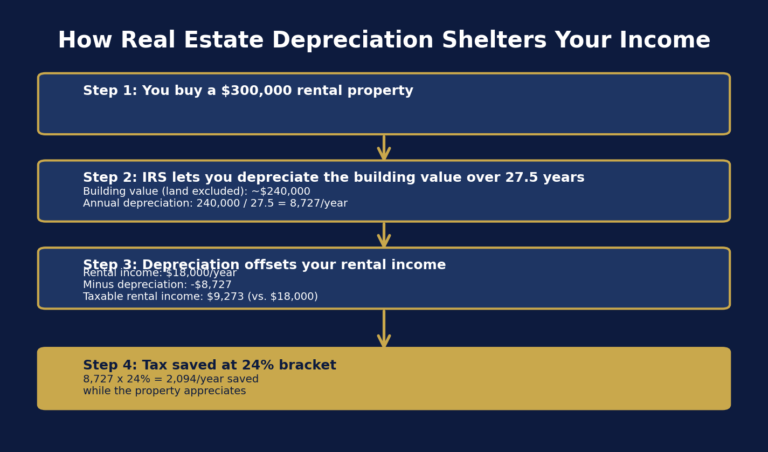
This is genuinely semi-passive at scale. A property manager (typically 8–10% of gross rent) makes it nearly fully passive. The major advantages: leverage, appreciation, depreciation (a powerful tax shield), and inflation protection. For W2 employees exploring real estate as a side income, see real estate investing on a W2 salary for a detailed guide.
Best platforms: Roofstock (turnkey rental marketplace), Bankrate Mortgage Calculator (for estimating financing)
Best for: Investors with capital who want leveraged, inflation-protected, tax-advantaged income.
3. REITs (Real Estate Investment Trusts)
Capital: Low to High (accessible with any amount)
Time to income: Fast (immediate)
Ongoing time: Near zero
Realistic ceiling: Scales with capital; 3–6% dividend yield typical
REITs give you real estate income without property management. Publicly traded REITs (like VNQ, O, STAG, or REXR) are required to distribute 90% of taxable income as dividends. Yields currently range from 3–7% depending on the REIT type.
A $200,000 REIT portfolio yielding 5% generates $10,000/year — paid quarterly, requiring zero active management.
Best platforms: Fundrise ($10 minimum, eREITs and eFunds), Arrived Homes ($100 minimum, fractional rentals), Fidelity, Vanguard
Best for: Passive real estate exposure without the management burden.
4. High-Yield Savings / T-Bills / Money Market
Capital: Low
Time to income: Immediate
Ongoing time: Near zero
Realistic ceiling: 4–5% APY in current environment; limited by cash allocation
Treasury bills (currently 4.5–5.25% yield), high-yield savings accounts (4–5%), and money market funds generate meaningful income on emergency fund and short-term cash reserves.
On $100,000 held in T-Bills at 5%: $5,000/year, fully liquid, with no credit risk (backed by the US government).
Best platforms: TreasuryDirect (buy T-bills directly, zero fee), Marcus by Goldman Sachs (4%+ APY), Ally (high-yield savings)
Best for: Efficient cash management and emergency funds.
Tier 2: Time Investment Required Upfront, Then Mostly Passive
5. Rental Arbitrage (Short-Term Rentals via Airbnb/VRBO)
Capital: Medium ($5,000–$20,000 setup)
Time to income: Fast (days after listing)
Ongoing time: 5–15 hours/month (or outsourced)
Realistic ceiling: $1,500–$6,000/month per unit
Rental arbitrage is leasing a long-term apartment and subletting it short-term on Airbnb or VRBO. You capture the difference between the long-term rental cost and short-term rental income.
In tourist cities, beach towns, and urban markets, this spread can be substantial: a $2,000/month apartment generating $4,500–$6,000/month in Airbnb revenue creates $2,000–$4,000/month in gross profit.
For mid-term rentals (30–90 days), Furnished Finder often offers higher margins and fewer restrictions than short-term platforms.
6. Digital Products (Templates, Presets, Toolkits)
Capital: Low
Time to income: Medium (3–6 months to first meaningful sales)
Ongoing time: 2–4 hours/month (customer support, occasional updates)
Realistic ceiling: $500–$15,000+/month with traction
A well-designed digital product sold through Gumroad, Teachable, or Kajabi generates income with no ongoing production cost. The classic examples: Notion templates, Excel financial models, Lightroom presets, PowerPoint decks, resume templates, design assets.
Realistic scenario: A financial modeling template for real estate investors priced at $49 sells 50 copies/month through Etsy SEO — $2,450/month with minimal ongoing effort after creation.
7. YouTube AdSense + Brand Deals
Capital: Low to Medium ($1,000–$3,000 basic setup)
Time to income: Slow (1,000 subscribers + 4,000 watch hours to monetize; typically 6–18 months)
Ongoing time: 10–30 hours/month (to maintain relevance and growth)
Realistic ceiling: $3,000–$50,000+/month for successful channels
YouTube is not fully passive — a channel that isn’t fed with regular content eventually declines. But a library of evergreen content (financial education, tutorials, how-to videos) generates ongoing ad revenue and affiliate income long after publication.
A finance channel with 100,000 subscribers in a high-CPM niche earns approximately $3,000–$8,000/month from AdSense alone, plus brand deal income of $1,000–$5,000 per sponsored video.
8. Print-on-Demand
Capital: Near zero
Time to income: Medium (1–6 months for traffic)
Ongoing time: 2–5 hours/month
Realistic ceiling: $500–$5,000+/month
Platforms like Merch by Amazon, Redbubble, or Printify allow you to upload designs that appear on t-shirts, mugs, phone cases, and other products. You receive a royalty per item sold; the platform handles printing, shipping, and customer service.
Finance-themed designs, niche humor, and targeted communities (specific professions, hobbies) tend to outperform generic content.
9. Online Course Income
Capital: Low to Medium (camera, editing software, hosting: $500–$3,000)
Time to income: Slow (6–18 months for meaningful revenue without an existing audience)
Ongoing time: 2–5 hours/month (after launch)
Realistic ceiling: $5,000–$100,000+/month with large audience
A course is genuinely passive once created and marketed. Platforms like Udemy, Teachable, and Kajabi offer different trade-offs: Udemy provides discovery but takes 25–37% commission; Teachable and Kajabi offer 80–95% margins but require you to drive all traffic.
A course priced at $197 that sells 30 units/month through email + organic traffic = $5,910/month.
Tier 3: Solid, If the Conditions Are Right
10. Peer-to-Peer Lending / Private Notes
Capital: Medium
Time to income: Medium (1–3 months after deployment)
Ongoing time: 2–4 hours/month
Realistic ceiling: 8–12% annual return on deployed capital
Private lending — real estate hard money lending or purchasing private mortgage notes — generates 8–12% interest income passively if underwritten correctly.
Best platforms: Prosper (peer lending), LendingClub (peer-to-peer lending)
Best for: Income-focused investors with underwriting knowledge.
11. Royalties — Music, Photography, Stock Video
Capital: Low
Time to income: Slow (months to years for meaningful royalty streams)
Ongoing time: Near zero once uploaded
Realistic ceiling: Highly variable; most creators earn $100–$2,000/month
Stock platforms pay royalties on licensed media. Photography: Shutterstock, Getty Images, Adobe Stock. Music: DistroKid, TuneCore. Video: Pond5.
A substantial catalog (2,000+ images or 200+ video clips) can generate $500–$2,000/month passively.
12. Affiliate Marketing (Content-Driven)
Capital: Low
Time to income: Slow (6–18 months for organic traffic)
Ongoing time: 5–10 hours/month
Realistic ceiling: $2,000–$30,000+/month with traffic
Affiliate marketing — promoting other companies’ products and earning a commission per referral — is the backbone of most successful personal finance blogs. Credit card referrals, brokerage accounts, and financial tools often pay $50–$500+ per conversion.
Without an audience, there’s nobody to refer. Building organic SEO traffic takes 12–24 months.
13. Mobile App Revenue (Simple Tools and Games)
Capital: Medium ($5,000–$30,000 in development, or DIY)
Time to income: Slow
Ongoing time: 2–5 hours/month (bug fixes, updates)
Realistic ceiling: $500–$50,000+/month; highly winner-take-most
A simple utility app (budgeting tool, calculator, tracker) in the right niche can generate subscription revenue. The economics are unforgiving for most apps; most generate essentially zero revenue. The exceptions — focused tools in underserved niches — can generate $2,000–$10,000/month passively.
14. Vending Machines / Laundromats / ATMs
Capital: Medium to High ($3,000–$25,000 per unit)
Time to income: Medium (30–60 days after installation)
Ongoing time: 2–4 hours/week (stocking, maintenance, cash collection)
Realistic ceiling: $300–$1,500/machine/month
Physical cash-flow businesses like vending machines, ATMs, and laundromats are genuinely semi-passive at scale. A well-placed vending machine in a high-traffic location nets $300–$800/month after product costs.
Location is everything. A hospital lobby, university dorm, or factory floor generates a multiple of a quiet office building.
15. Parking Lot / Storage Space Rental
Capital: High (if acquiring land) or Low (if you already own)
Time to income: Fast (days to weeks)
Ongoing time: Near zero
Realistic ceiling: $100–$2,000+/space/month
If you own property with unused parking or storage space, monetizing it is one of the highest-ROI passive income moves possible. A city parking spot that rents for $200–$400/month generates that income for essentially zero ongoing effort.
Best platforms: Neighbor.com (storage space rental), SpotHero (parking spot rental)
Complete Passive Income Streams Comparison
| Stream | Startup Cost | Monthly Potential | Passivity Level (1-5) | Time to First $ | Best Platform | Link |
|---|---|---|---|---|---|---|
| Dividend Stocks | High ($50k+) | $200–$2,000+ | 5 | Immediate | Fidelity | https://www.fidelity.com |
| Long-Term Rentals | High ($30k–$100k) | $500–$2,000 | 3 | 1–3 months | Roofstock | https://www.roofstock.com |
| REITs | Low–High | $50–$1,000+ | 5 | Immediate | Fundrise | https://www.fundrise.com |
| High-Yield Savings | Low | $30–$400 | 5 | Immediate | TreasuryDirect | https://www.treasurydirect.gov |
| Rental Arbitrage (Airbnb) | Medium ($5k–$20k) | $1,500–$6,000 | 2 | Days | Airbnb | https://www.airbnb.com |
| Digital Products | Low | $500–$1,500 | 4 | 3–6 months | Gumroad | https://www.gumroad.com |
| YouTube AdSense | Low–Medium | $500–$3,000 | 3 | 6–18 months | YouTube | https://www.youtube.com |
| Print-on-Demand | Near zero | $300–$1,000 | 4 | 1–6 months | Merch by Amazon | https://www.merch.amazon.com |
| Online Courses | Low–Medium ($500–$3k) | $1,000–$5,000 | 3 | 6–18 months | Teachable | https://www.teachable.com |
| P2P Lending | Medium | $300–$1,000 | 4 | 1–3 months | Prosper | https://www.prosper.com |
| Royalties (Music/Photo) | Low | $100–$2,000 | 5 | 1–12 months | DistroKid | https://www.distrokid.com |
| Affiliate Marketing | Low | $200–$2,000 | 3 | 6–18 months | Your blog + Amazon Associates | https://affiliate-program.amazon.com |
| Mobile Apps | Medium ($5k–$30k) | $200–$2,000 | 3 | 3–12 months | App Store / Google Play | https://play.google.com |
| Vending Machines | Medium ($3k–$25k) | $300–$1,500 | 3 | 1–2 months | Local operators | N/A |
| Parking / Storage | Low–High | $100–$2,000 | 5 | Days–weeks | Neighbor.com | https://www.neighbor.com |
The Honest Truth About Passive Income
No passive income stream goes from zero to meaningful money without either capital or time investment upfront. The question isn’t “how do I find passive income?” — it’s “what combination of capital and time can I deploy right now to build a stream that compounds over time?”
For most wealth-builders, the optimal approach is a portfolio:
– Core: dividend stocks and real estate (capital-efficient, scalable, tax-advantaged)
– Growth: one content-based stream (blog, YouTube, or course) that builds over 2–3 years
– Opportunistic: one asset or tool-based stream (digital products, rental arbitrage, parking) that requires minimal capital and starts generating quickly
Diversification across passive income streams reduces the risk that any one source dries up — and creates the kind of financial resilience that true independence requires.
Related Reading
- Real Estate Investing on a W2 Salary: The Complete Starter Guide — Deep dive on the #1 ranked passive income stream
- The Best Side Hustles for W2 Employees in 2026 — Active income streams that fund passive ones
- How $500/Month in Side Income Can Take Years Off Your FIRE Timeline — The math on what these income streams do to your retirement date
- The Wealthy Borrow, Everyone Else Sells: Portfolio Arbitrage — How to borrow against your passive income assets instead of selling them
Frequently Asked Questions
Which passive income stream is best for beginners with no capital?
Digital products, print-on-demand, or affiliate marketing require minimal capital ($0–$500) and can generate $500–$2,000/month once you build an audience. However, they require 6–18 months of work before meaningful income. If you have capital but no time, dividend stocks are the easiest path.
Can I combine multiple passive income streams?
Yes — this is the recommended approach. A typical FIRE builder might have dividend stocks (foundation), one rental property (leverage), and a digital product or blog (upside). This diversification reduces single-stream risk.
How much can I realistically earn from passive income?
This depends entirely on your starting capital and time investment. Someone with $1 million in dividend stocks and zero time investment might earn $40,000–$50,000/year. Someone with zero capital but 20 hours/week building a blog could reach $2,000–$5,000/month in 2–3 years.
Is passive income actually “passive”?
No — most streams require either ongoing maintenance (content creation, property management) or upfront hustle (course creation, audience building). The “passive” part is that, once established, the income doesn’t require trading hours for dollars in real-time.
What’s the fastest passive income stream to start?
High-yield savings (immediate), REITs (immediate), and rental arbitrage (days to weeks) are the fastest. Meaningful income ($500+/month) is typically 1–3 months away with these approaches.
Can I live entirely on passive income?
Yes, but it requires either significant capital ($1M+ yielding 4%, depending on lifestyle) or a diverse portfolio of 5+ streams generating $3,000–$5,000+/month combined. Most successful early retirees rely on a combination of all three: stock dividends, real estate, and content/affiliate income.
Affiliate Disclosure: Some links on this page are affiliate links. If you sign up through our link, Aedilis may earn a commission at no additional cost to you. We only recommend products we believe provide genuine value to your financial journey. Our editorial opinions are always our own.
This article is for informational purposes only and does not constitute financial, investment, or tax advice. All income figures are illustrative estimates. Consult qualified professionals before making investment decisions.