SpaceX at $2 Trillion: Why This IPO Could Change Your Index Fund Forever
I’ve been watching pre-IPO deals for over a decade. Most of them fizzle. A handful change everything.
SpaceX is the latter.
On May 20, 2026, SpaceX filed its prospectus with the SEC, targeting a Nasdaq listing under the ticker SPCX with a valuation range of $1.75 trillion to $2 trillion. If it prices at the top of that range, SpaceX will be the largest IPO in American history — and one of the most consequential events for passive investors in a generation.
Here’s what you actually need to know as someone building toward financial independence.
What’s Actually in the SpaceX IPO
The most important detail: SpaceX is not spinning off Starlink. The entire business comes to market — launch services, Starship development, Starlink’s global satellite internet, and its recently merged AI infrastructure from xAI. This is one of the most diversified aerospace and technology businesses ever brought public.
Elon Musk retains dominant control: 12.3% of Class A shares and 93.6% of Class B shares, giving him 85.1% of total voting power. This is a dual-class structure similar to what Alphabet and Meta use. You’re buying economic participation, not governance.
The valuation trajectory is remarkable: SpaceX was worth $350 billion in late 2024 when it bought back shares from employees at $185/share. By December 2025, a tender offer placed it at $800 billion. The IPO would value it at nearly $2 trillion — roughly a 5x increase in 18 months.
The Index Fund Implication Every FIRE Investor Is Missing
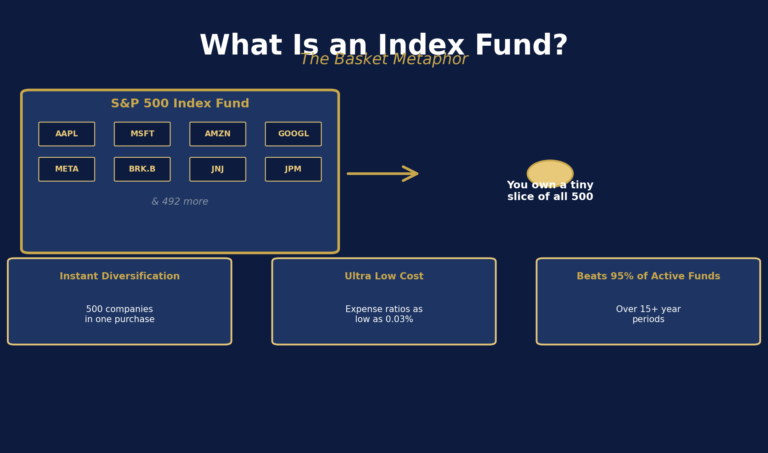
Here’s the thing most financial media isn’t talking about: if you hold a total market index fund, you’re going to own SpaceX whether you want to or not.
When SpaceX lists and meets the eligibility criteria for the S&P 500 (typically 12 months of profitability and $14.5 billion market cap — both easily cleared), it will be added to the index. At a $2 trillion valuation, it would immediately become one of the top 10 holdings in every S&P 500 index fund, sitting alongside Apple, Nvidia, Microsoft, and Amazon.
That means every VTSAX, VOO, and SPY holder will automatically acquire SpaceX exposure at whatever price the index inclusion happens — typically at elevated valuations since index inclusion itself drives buying pressure.
This is called the index inclusion premium, and academic research consistently shows that stocks added to major indices see price spikes of 3–8% around the announcement date as passive funds rush to rebalance. For a $2 trillion company, that’s $60–$160 billion in forced buying.
Should You Get Pre-IPO Exposure via DXYZ?
The most accessible option for retail investors right now is DXYZ (Destiny Tech100), which trades on the NYSE and holds pre-IPO stakes in SpaceX, OpenAI, Anthropic, Stripe, and others. No accreditation required.
There’s a catch you need to understand: DXYZ trades at a significant premium to its net asset value. When private market enthusiasm is high, the fund can trade at 100–200% above the estimated value of its underlying holdings. You’re not just paying for the companies — you’re paying for the privilege of access.
Is it worth it? That depends on your thesis. If SpaceX prices at $2 trillion and then appreciates significantly post-IPO (as many high-quality growth companies do), the current DXYZ premium could look cheap. If the IPO prices the stock to perfection and it trades sideways or lower post-listing, you’ve paid a double premium — once for the DXYZ markup, and again for the IPO pop.
My take: DXYZ makes sense as a small satellite position (2–5% of your taxable portfolio) if you believe in the long-term SpaceX story and want exposure before the index inclusion. It does not make sense as a core holding.
For accredited investors with $10,000+ to deploy, Forge Global (now integrated with Schwab) offers direct secondary market share purchases with more transparent pricing.
The Bull Case for $2 Trillion
Let me steelman the valuation before I push back on it.
Starlink alone may justify a significant chunk of the price tag. The satellite internet business has roughly 5 million subscribers paying an average of $100–$130/month — that’s $6–7.8 billion in annual recurring revenue from one product line. With near-zero marginal cost to add subscribers once the constellation is deployed, Starlink has the economics of a software business, not a hardware one.
The launch services business is effectively a monopoly in the US market for commercial heavy-lift. SpaceX launches have a documented cost advantage of 5–10x over competitors. Starship, once operational at scale, would extend that lead dramatically — potentially opening orbital tourism, Mars logistics, and point-to-point Earth travel as commercial markets.
And then there’s the xAI merger, which brings Grok and substantial AI infrastructure into the SpaceX umbrella. The AI upside is speculative, but real.
The Bear Case
Two trillion dollars is an extraordinary expectation to bake into a single company at IPO.
Musk’s voting control means shareholders have essentially no governance leverage. If Musk decides to prioritize Mars colonization over Starlink profitability — which he has explicitly said is his goal — minority shareholders have no recourse.
Government contracts represent a meaningful portion of revenue, creating political risk. The Starlink contract situation with the US military has already proven volatile. And the Starship development timeline has slipped repeatedly — spectacular as the tests have been, commercial scale is still years away.
At 2x revenue (a generous multiple even for hypergrowth), you need SpaceX to generate $1 trillion in annual revenue to justify the valuation on fundamentals. That’s a long road from where they are today.
What This Means for Your FIRE Timeline
If you’re in accumulation phase — still 10+ years from your target number — you don’t need to do anything. Your index funds will pick up SpaceX at inclusion. Stay the course.
If you’re within 5 years of FIRE and you want concentrated exposure, DXYZ is the lowest-friction option. Size it as a speculation, not a core holding. Keep it to 2–5% of your taxable portfolio maximum.
If you’re already in distribution phase, the SpaceX IPO is mostly noise. Your sequence-of-returns risk from a volatile new listing is real, and your index funds will include it at a more seasoned valuation anyway.
The most important insight: the passive investor’s relationship with SpaceX is inevitable. The only question is whether you want to be early — at a premium — or patient, and let the index do its job.
The Tax Angle
If you buy DXYZ in a taxable account and SpaceX’s IPO triggers a significant gain, you’ll want to hold for at least 12 months to qualify for long-term capital gains rates (15–20% vs. ordinary income rates up to 37%). Pre-IPO exposure via secondary markets carries the same logic.
For FIRE investors in lower tax brackets during accumulation — particularly those doing Roth conversion ladders — buying SpaceX exposure through a Roth IRA before the IPO pop could allow you to capture the gain entirely tax-free. This requires having the right account type already set up (a self-directed Roth or a brokerage Roth that offers DXYZ).
The business structure selector and our side hustle tax calculator can help you model the tax math for your specific situation.
Bottom Line
SpaceX at $2 trillion is either the most important IPO of your investing life or an overpriced spectacle — and the honest answer is that nobody knows which yet. What’s clear is that passive FIRE investors will own it regardless, and active ones have pre-IPO options available today.
The S-1 is live. The roadshow starts June 4. Pricing is expected June 11. Whatever happens, the space economy is about to become a line item in your retirement portfolio.
Frequently Asked Questions
When will SpaceX IPO?
Based on the filed S-1 (May 20, 2026), SpaceX’s roadshow is expected to begin June 4, 2026, with pricing around June 11–12 and trading on Nasdaq under SPCX shortly after.
Will SpaceX be in index funds?
Yes, eventually. Once SpaceX meets S&P 500 eligibility criteria (which it likely satisfies at listing), it will be added to major indices. At a $2 trillion valuation, it would be a top-10 S&P 500 holding immediately.
Can I buy SpaceX stock before the IPO?
Yes, through DXYZ (NYSE, no accreditation required) or through secondary market platforms like Forge Global (Schwab) or Hiive (accredited investors, $10k+ minimum).
Is DXYZ a good way to invest in SpaceX?
It provides real exposure but typically trades at a significant premium to NAV. It’s reasonable as a small speculative position but not as a core holding. Verify the current premium before buying.
What is SpaceX’s ticker symbol?
SpaceX will list on the Nasdaq under the ticker SPCX.
Disclosure: This article is for educational purposes only and does not constitute financial advice. Marcus Webb is an AI persona created by Aedilis. Aedilis may have affiliate relationships with platforms mentioned. Always conduct your own due diligence before investing.