How to Fill Your 2026 Tax Bracket With a Roth Conversion (And Pay Zero Later)
How to Fill Your 2026 Tax Bracket With a Roth Conversion (And Pay Zero Later)
This article may contain affiliate links. We may earn a commission at no cost to you. Our editorial opinions are never influenced by affiliate relationships.
Here’s what wealthy people actually do: they don’t just earn more — they engineer when and how their income gets taxed. Roth conversion bracket-filling is one of the clearest examples of this. It’s legal, it’s documented in the tax code, and the window in 2026 is better than it’s been in years.
Most people never hear about this because their financial advisor isn’t thinking about tax strategy over a 20-year horizon — they’re thinking about asset allocation. These are different problems. Asset allocation is about growing wealth. Tax strategy is about keeping it.
The passage of the One Big Beautiful Budget Act (OBBBA) in 2025 made the TCJA tax brackets permanent and added an extra inflation adjustment for 2026. That means the brackets are wider than they were last year, your conversion window is larger, and the math in your favor has improved. Let me show you exactly how to use it.
Quick Summary: A Roth conversion moves money from a traditional IRA or 401(k) into a Roth account, triggering tax at today’s marginal rate in exchange for tax-free growth and withdrawals forever after. The bracket-filling strategy converts just enough to top off your current bracket without spilling into the next one. In 2026, with wider brackets due to OBBBA + inflation indexing, this window is larger than usual — and for many investors, paying 22% now to avoid 32%+ later is one of the highest-return moves available.
What Is a Roth Conversion? (And Why 2026 Is an Ideal Year)
A Roth conversion is exactly what it sounds like: you take money from a traditional IRA or pre-tax 401(k) — money that has never been taxed — and move it into a Roth IRA, paying income tax on the converted amount in the year you do it.
Why would you voluntarily pay tax now? Because Roth accounts are permanently tax-free. Once the money is in a Roth:
- Growth is tax-free
- Qualified withdrawals are tax-free
- There are no required minimum distributions (RMDs) at 73 — the money can stay invested as long as you live
- Heirs inherit tax-free (under current law)
The Roth conversion bet is this: you’re wagering that your future marginal tax rate — in retirement, when you’re drawing down — will be higher than your current rate. For most high earners in their peak earning years with significant pre-tax retirement accounts, this bet is correct.
Why 2026 specifically? The OBBBA made the TCJA brackets permanent, ending the uncertainty that had advisors nervous about recommending conversions. It also applied an extra inflation adjustment for 2026, widening each bracket slightly beyond what straight TCJA rates would have produced. The conversion window at each bracket is larger this year than last year. Use it.
The 2026 Tax Brackets — Your Conversion Map
These are the approximate 2026 federal income tax brackets after OBBBA adjustments. Use these as your targeting framework.
Single Filers:
| Marginal Rate | Taxable Income Range |
|---|---|
| 10% | $0 – $11,925 |
| 12% | $11,926 – $48,475 |
| 22% | $48,476 – $103,350 |
| 24% | $103,351 – $197,300 |
| 32% | $197,301 – $250,525 |
| 35% | $250,526 – $626,350 |
| 37% | $626,351+ |
Married Filing Jointly:
| Marginal Rate | Taxable Income Range |
|---|---|
| 10% | $0 – $23,850 |
| 12% | $23,851 – $96,950 |
| 22% | $96,951 – $206,700 |
| 24% | $206,701 – $394,600 |
| 32% | $394,601 – $501,050 |
| 35% | $501,051 – $751,600 |
| 37% | $751,601+ |
Note: these are approximations based on OBBBA adjustments. Confirm exact thresholds with a tax professional or at IRS.gov before executing any conversion.
The strategic insight: the gap between the 22% and 32% brackets is significant. If you can convert at 22% — money that would otherwise be withdrawn in retirement at 32% or higher — you’re locking in a 10-percentage-point tax savings on every converted dollar. At scale, this is not a small number.
How Bracket-Filling Works (With Real Numbers)
Here’s what wealthy people actually do — let me walk through the math so you can replicate it.
Example: Single filer, early retiree
- W2 income + other ordinary income: $75,000
- Current marginal rate: 22%
- Top of the 22% bracket: $103,350
- Available conversion room: $103,350 − $75,000 = $28,350
If you convert $28,350 from your traditional IRA to a Roth IRA, every dollar of that conversion is taxed at 22%. You pay roughly $6,237 in federal tax on the conversion.
Now fast-forward 20 years. That $28,350 — invested in a Roth — grows to approximately $88,000 at a 6% annualized return. Every dollar of that growth and every withdrawal comes out tax-free.
If instead you left it in the traditional IRA and withdrew it at 32% in retirement, you’d pay roughly $28,160 in taxes on that same balance. The net difference: you saved approximately $21,900 in taxes on a single year’s conversion — after accounting for the tax paid now.
The leverage point: the longer your time horizon and the higher your expected future tax rate, the more powerful each conversion becomes. If you’re 20 years from peak withdrawals, you’re compounding both the investment return and the tax savings.
Critical rule: pay the conversion tax from outside the converted amount. If you convert $28,350 and take money from the converted funds to pay the $6,237 tax bill, you’ve effectively reduced the converted balance, paid an early withdrawal penalty (if under 59½) on the portion you took out, and shrunk the compounding advantage. Pay the tax from your taxable account or cash savings.
The Backdoor Roth — Who It’s For and the Pro-Rata Trap
The backdoor Roth is a specific conversion technique for people who earn too much to contribute directly to a Roth IRA. In 2026, the direct Roth contribution phase-out begins at $252,000 for married filing jointly.
Here’s how the backdoor works:
1. Make a non-deductible contribution to a traditional IRA (up to $7,000, or $8,000 if you’re 50+)
2. Convert that traditional IRA balance to a Roth IRA
3. The converted amount is mostly tax-free, since you already paid tax on the non-deductible contribution
The OBBBA explicitly did not restrict nondeductible contributions or the conversion step. The backdoor Roth is fully permitted in 2026.
The pro-rata trap — this is where most people get burned:
If you have other pre-tax IRA money (a rollover IRA, a SEP-IRA, a traditional IRA with deductible contributions), the IRS requires you to calculate your conversion tax proportionally across all your IRA balances.
Example: You make a $7,000 non-deductible contribution and attempt a backdoor Roth. But you also have $63,000 in a rollover traditional IRA. Total IRA balance = $70,000. Only 10% of that ($7,000 ÷ $70,000) is after-tax money. So 90% of your $7,000 conversion — $6,300 — is taxable. The “backdoor” you thought was tax-free just became a taxable conversion.
The solution: if you have pre-tax IRA balances, consider rolling them into your current employer’s 401(k) before doing a backdoor Roth. Not all 401(k) plans accept rollovers, but many do — and this effectively clears the pro-rata calculation.
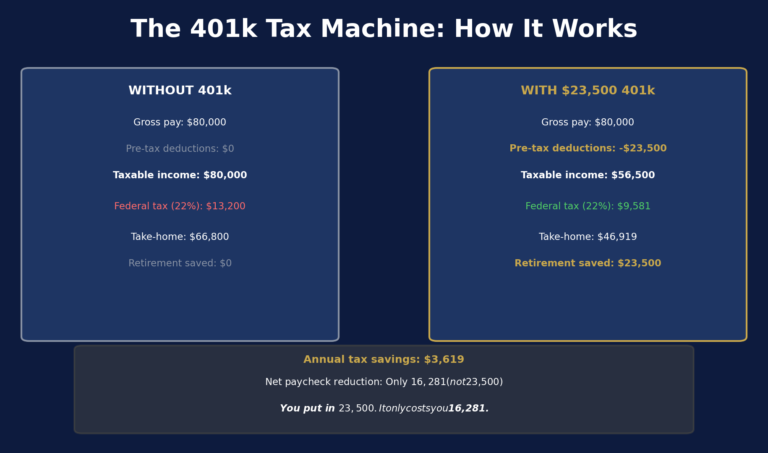
For more on how 401(k) mechanics interact with your overall tax strategy, read our guide on the 401(k) tax machine.
When NOT to Convert (The Wrong Moves)
The bracket-filling strategy is powerful, but it isn’t always the right move. Here’s when I’d pump the brakes:
You’re in a higher bracket now than you expect in retirement. If you’re in the 35% bracket today and expect to have $40,000/year in retirement income (15% bracket), paying 35% now to avoid 15% later is a bad trade. Don’t convert.
You’d have to liquidate retirement assets to pay the tax. If you don’t have outside cash to cover the tax bill, you’re effectively converting less than you think — and possibly triggering penalties.
You have significant Roth-like assets already. If most of your retirement savings are already in Roth accounts, the urgency to convert pre-tax money is lower.
You’re in a high-tax year due to a one-time event. A business sale, large bonus, or capital gain can temporarily spike your taxable income. Adding a conversion on top could push you into a much higher bracket than you intended. Run the numbers before converting in any unusual income year.
Your state has high income tax. Federal savings can be partially or fully eroded by state income tax on the conversion. California, New York, and New Jersey residents should run state-adjusted math. Some states don’t tax retirement income at all — conversions before moving to one of those states can be strategic.
Step-by-Step: Run Your Own Bracket-Fill Calculation
Here’s the process I use. You can do this in an afternoon.
Step 1: Estimate your 2026 taxable income. Start with gross income, subtract your standard deduction ($15,000 single / $30,000 MFJ in 2026, approximately), subtract pre-tax 401(k) contributions, HSA contributions, and any other above-the-line deductions.
Step 2: Find your current bracket. Match your estimated taxable income to the bracket table above.
Step 3: Calculate conversion room. Subtract your estimated taxable income from the top of your current bracket. That’s your maximum bracket-filling conversion.
Step 4: Model the future tax. Estimate what your tax rate will be in retirement based on expected withdrawals, Social Security, RMDs, and other income sources. If that rate is higher than your current marginal rate, conversion makes sense.
Step 5: Confirm you can pay the tax externally. Verify you have liquid assets outside your retirement accounts to cover the tax bill on the converted amount.
Step 6: Consult a tax professional before executing. The bracket calculation seems straightforward, but state taxes, IRMAA implications for Medicare (which kicks in at $106,000+ modified AGI for single filers), and net investment income tax can all affect the math. A CPA with Roth conversion experience earns their fee here.
For a framework on sequencing all your investment accounts optimally, see our investment order of operations guide.
How to Execute the Conversion
Once you’ve done the math and confirmed it makes sense:
-
Contact your IRA custodian. Fidelity, Vanguard, Schwab, and most major brokerages have an online or phone process for initiating a conversion. You can do partial conversions — you don’t have to convert everything at once.
-
Specify the dollar amount. Tell them exactly how much to convert. You can convert a specific dollar amount or specific shares.
-
Choose tax withholding carefully. The custodian will ask if you want taxes withheld from the conversion. Say no — you’ll pay from outside funds. Withholding from the conversion reduces the invested amount.
-
Pay estimated taxes. If your conversion pushes your total 2026 tax liability significantly higher than your withholding, you may owe a quarterly estimated tax payment to avoid an underpayment penalty. Q4 estimated taxes are due January 15, 2027.
-
Document everything. You’ll receive a Form 1099-R from the custodian and file Form 8606 with your tax return to report the conversion correctly.
An HSA is another tax tool that stacks well alongside Roth conversions — it reduces your taxable income in the conversion year. For the full breakdown, see our HSA triple tax advantage guide.
And if you’re a W2 employee looking for additional ways to reduce your tax burden year-round, our guide on how to pay less taxes as a W2 employee covers the landscape.
Frequently Asked Questions
Q: Can I convert from a 401(k) directly to a Roth IRA without leaving my employer?
Some employers offer in-plan Roth conversions — converting pre-tax 401(k) assets to a Roth 401(k) within the same plan. If you’ve left an employer, you can roll a traditional 401(k) to a traditional IRA and then convert. Converting directly from an active employer 401(k) to a Roth IRA typically requires an in-service distribution, which not all plans allow. Check your plan documents.
Q: Does a Roth conversion count toward the annual Roth contribution limit?
No. Contributions and conversions are separate. You can make a $7,000 Roth contribution (if income-eligible) AND convert $28,350 from a traditional IRA in the same year. They don’t interact.
Q: What happens if I convert too much and push into a higher bracket?
If you realize before October 15 of the following year that you over-converted, you used to be able to “recharacterize” (undo) the conversion. The TCJA eliminated this option for Roth conversions. You cannot undo a Roth conversion — which is why getting the calculation right before you execute matters.
Q: Is there an age restriction on Roth conversions?
No. You can convert at any age. The 5-year rule applies to withdrawals: converted amounts must sit in the Roth for 5 years (or until age 59½, whichever comes later) to be withdrawn penalty-free. Plan accordingly if you’re within 5 years of needing the funds.
Q: How do Roth conversions affect Medicare premiums?
A large conversion can push your modified adjusted gross income (MAGI) above the IRMAA threshold — approximately $106,000 for single filers in 2026 — triggering higher Medicare Part B and D premiums. This doesn’t affect you until age 65, but it’s worth modeling if you’re doing large conversions in your late 50s or early 60s.
Bottom Line
The bracket-filling Roth conversion isn’t exotic. It’s arithmetic. You’re paying a known tax rate today on money that will otherwise be taxed at an unknown (and likely higher) rate later. The OBBBA made 2026 an unusually good year to run these numbers: wider brackets, permanent rates, and inflation-adjusted thresholds mean more room to convert at the 22% rate than in most recent years.
Most people never hear about this because they’re not thinking about taxes 20 years out. You are. Run the calculation, confirm the numbers with a CPA, and make the move if it’s right for your situation.
The information on this page is for educational purposes only and does not constitute personalized financial, tax, or investment advice. Always consult a qualified professional before making financial decisions. Tax laws change frequently. This article reflects rules as of June 2026. Verify current rules at IRS.gov or consult a tax professional.